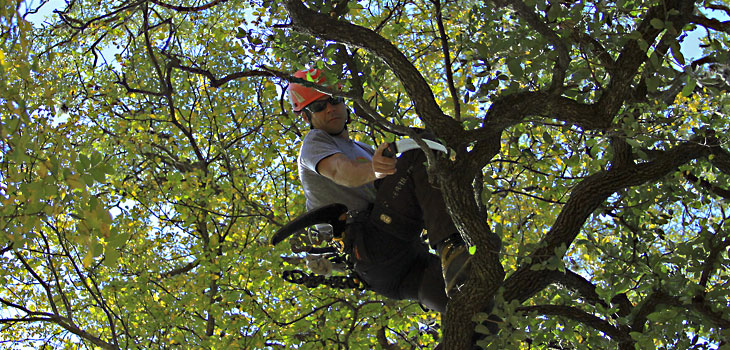
Why hire an ISA Certified Arborist

Taking care of your trees extends the life of the tree, adds property value and increases safety for your home and or environment. The benefits of trees range from purifying our air, helping to mediate water run off, and can dramatically increase efficiency in cooling and heating your home. Also they provide wildlife habitat and give us a more pleasant place to live.

Proper pruning is essential in establishing and maintaining a tree with strong structure and desirable form. Young trees appropriately pruned will require less attention as they mature than ones that haven’t. Poor pruning caused by inadequately trained workers with little or no knowledge of tree biology can cause irreparable damage. This will last for the lifespan of the tree or worse even shorten it’s life.
An ISA certified arborist is a specialist in the care of individual trees, they are knowledgeable about the needs of trees and are trained and equipped to provide proper care. Pruning and removing trees, especially large ones, can be dangerous work and should be done by those with extensive training, proper equipment and adequate liability insurance.

Tree planting considerations

Planting a tree is a long term investment. There are many important factors to consider when establishing a plan for planting.These include selecting species, location and following up with proper planting techniques.

  Although some non native species will adapt to our soils and landscapes it is important to consider native trees for selection. Even though soil amendments can be made to accommodate non native smaller plants and ornamentals, trees require a more extensive area for root growth. Changing the structure of the soil can be a costly repetitive process, with little or no permanent effect.

When selecting a tree it is also important to understand genetic growth patterns inherent to the species. The height and width of a mature tree will determine if the desired location is suitable for the life of the tree. Presence of power lines, structures, and underground utilities must all be considered. Poor placement requires aggressive pruning to accommodate for limited space which results in the overall decline of the tree.

When the right species and location are determined, the planting depth, nursery stock quality, and soil and hole preparation are all key to your tree’s establishment. Recommended planting times in our region are during dormancy which is late fall and winter. For recommendations and installation specific to your property please contact TreeWeaver for a consultation.

Epicormic sprouts and their role in the health of the tree.

Epicormic sprouts, also known as “suckers” or “water sprouts”, are growth that emerge from dormant buds along the trunk and branches of a tree. Some species of tree produce a large quantity of these sprouts such as a Live oak (Quercus virginiana), wheras others such as a Sycamore (Platanus occidentalis) will produce comparatively very few.

The sprouts may appear for a variety of reasons, mostly on parts of a tree that are newly exposed to sunlight but in urban areas are often a symptom of stress in a tree. Trees that have suffered storm related damage or that have been overly pruned and thinned will grow epicormic sprouts to compensate for the loss of leaf surface.

A commom practice, to “improve” the aesthetics of the tree, is to remove this growth either partially or completely to the tips of the branches, referred to in arboriculture as” lion-tailing”. This causes stress in the tree for many different reasons. The tree grows these sprouts first and foremost when there is a need to increase amounts of photosynthesis, and it does require a lot energy and resources to generate the growth. These sprouts also serve the purpose of protecting bark that is directly exposed to sunlight by providing shade for it. Sun scald is a common cause of decline in trees in Texas. With continuous exposure to the sun the bark will begin to crack, exposing the vascular system and making it vulnerable to entry of pests which will accelerate the decay of the wood, making the branch vulnerable to breakage. Lion-tailed branches also have a very high tendency to break under heavy winds as the sail, or leaves, are all on the tip  instead of being spread out along the branch where it can better deal with wind pressure.  When an epicormic sprout is well developed it also offers the arborist an option of pruning  back to it in case the tip of the brach has died or broken, preserving more of the branch and decreasing the amount of stress and wounding that would happen if the whole stem had to be removed back at the trunk.

It’s worth adding that when epicormic sprouts are removed, it triggers more of them to grow as the tree will need more photosynthetic tissue to compensate for the wounding, thus defeating the purpose of removing them in the first place. The best practice is to remove a small percentage of the weaker ones that are growing in undesirable places such as by major branch unions or over a structure, and allowing the rest to develop and self regulate. Some sprouts  will become more dominant, shading out others and eventually turning into tissue that will resemble a branch.

Ball Moss

Tillantsia recurvata

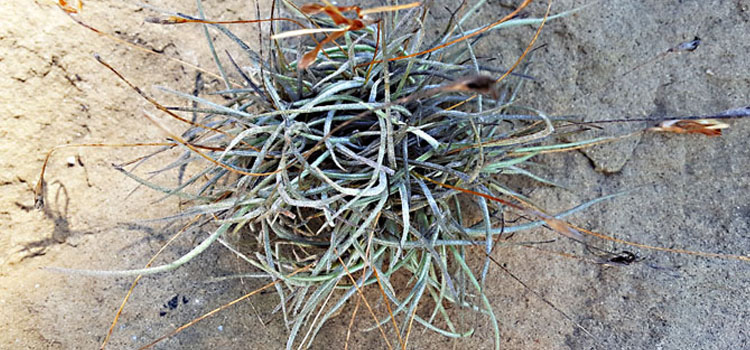
Ball Moss is a small epiphyte commonly found on limbs of live oaks and other trees in central Texas. Ball moss is not a moss as the name would suggest, but a plant in its own right with flower and seeds, in the bromeliad family.

Epiphytes are non parasitic plants that place false roots to aerial structures such as tree trunks, tree limbs, and even non organic places such as power lines or a fence. The false roots do not actually perform like true roots which uptake water and minerals.  If non parasitic, homeowners often ask why it is commonly found on dead or declining branches. This is because ball moss favours an environment with low sunlight and adequate humidity which happens to be in the interior of a tree canopy. While the interior of a canopy is favourable to epiphytes, it is also an area where conditions are not ideal for photosynthesis and healthy  tree growth, thus the presence of dead and dying branches. Live oaks in particular, with their thick layering canopies, provide an ideal environment where ball moss can thrive.

If the presence of this epiphyte is light to moderate, it is a question of aesthetics, which can easily be addressed with periodic removal of dead wood. Pruning dead wood will typically reduce ball moss infestation by 70% to 80%. If the presence of ball moss is heavy or extends to outer parts of the canopy it can reduce airflow and block sunlight, thus inhibiting new growth. Therefore a more thorough reduction of ball moss may be required to ensure the health of the host tree. This can only be achieved by your certified arborist climbing the outer portions of the canopy and hand picking the ball moss. While spraying baking soda or Kocide 101 has proved effective in killing  ball moss, it doesn’t physically remove it from the tree. This can be both unsightly and often become a host and nesting ground for unwanted insects. 

Ball moss will never be permanently eradicated but proper pruning and regular mainetnance on your trees will ensure it’s population is kept under control. If you have any additional questions or need an on site visit from one of our ISA certified arborists please don’t hesitate to get in touch.

Oak wilt and pruning.

Oak wilt is a serious and often fatal disease caused by the fungus Ceratocystis fagacearum. Central Texas is one of the worst afflicted areas in the U.S., damaging and killing numerous live oaks and red oaks. Most home owners, where these trees are present, are familiar with the danger this fungus causes, but aren’t sure on how and when to prune oak wilt susceptible trees.

Oak wilt spreads in two ways. Below ground, through the grafting of roots of different trees and above ground, carried by a vector in the shape of a sap feeding beetle called a Nitidulid.

Over 95% of oak wilt transmission occurs underground (Juzwik 1983), making it a difficult disease to prevent as it often involves trenching between properties to keep it contained.

Over ground transmission, and this is where pruning comes into play, may occur when the Nitidulid, attracted to the scent of exposed green woody tissue, whether from a pruning cut or scrape from contact with a building, deposits the fungal spores from another infected tree. To prevent this from happening the arborist needs to sanitize all cutting tools between trees and cover the wound with a thin layer of non-toxic paint immediately after the cut is made. About 24 hours after the cut is made the tree will have sealed the exposed tissue on his own, so it is important to protect our oaks for this initial period. If pruning dead wood, where the correct cut exposes only non conductive tissue, painting the wound isn’t necessary but is done anyways so as to let the public know that all precautions have been taken. 

Some neighborhoods in Austin stress the importance of avoiding pruning of live oaks and red oaks in the spring months, when the beetle activity is very high. These reccomendations often lead to confusion, beetle activity doesn’t follow seasons but temperature patterns, and these patterns vary greatly from year to year.  If all precautions are taken, the sanitising of the tools and immediate treatment of the wound, there is no problem pruning oaks year round.

It is worth noting that although oak wilt is a devastating disease, the damage it causes is relatively small when compared to the damage caused by the poor pruning practices performed by many unqualified “tree guys” in our city. These precautions need to always be backed up by proper care for the all round health of the tree.

Pruning in relation to temperature.

Homeowners often hear conflicting information about what kind of pruning can be performed at what time of the year. Part of the confusion is related to the pruning of live oaks and red oaks because of the risk of oak wilt transmission, which will be specifically addressed in the next blog.

Pruning can be broadly divided into two kinds, removal of dead branches and removal of green branches. Pruning dead tissue out of a tree (often referred to in the industry as “deadwooding”), regardless of species, when cuts are done correctly at the branch collar by an ISA certified arborist, is fine to do year round as the cut is brought back to non conductive tissue where it won’t negatively affect the health of the tree. Infact, removing dead wood from about 2″ in diameter and larger is greatly beneficial as the tree can avoid using it’s resources trying to grow callous wood to absciss the dead branch on its own.

Pruning green tissue on a tree is more complex and different factors need to be kept into consideration, mainly the age of the tree and the amount of green branches that need to be removed. Also the species and the condition of the tree are important factors but for the sake of making this blog clear and concise we have to speak in general terms, so consulting with an arborist is often necessary. Mature trees are fairly intolerant to having green tissue removed and there should always be a reason to prune in the first place, whether to reduce or remove a hazardous limb, remove a rubbing branch or to clear the canopy for structures, roadways and driveways. If the amount of branches is moderate this can be done year round, if more extensive work is needed it is best to do it when the tree’s vascular system is at it’s slowest. This happens when outdoor temperatures are at extremes, when any part of the day is in the low nineties and above or below the mid forties, typically our summers and short lived winters. Pruning at these times of the year greatly reduces negative impact on the tree and avoids excessive stimulation of epicormic sprouts. The same temperature parameters apply to to young trees but larger amounts of green tissue can be removed in one growing season without damaging the tree’s health, making it an ideal age for pruning for good structure thus avoiding future problems and being forced to remove larger amounts of green as the tree matures.

I would like to reiterate that these are general guidelines and each individual tree needs to be examined carefully before deciding what kind of pruning needs to be performed and when to do it. Don’t hesitate to call your arborist for advice.

Mistletoe

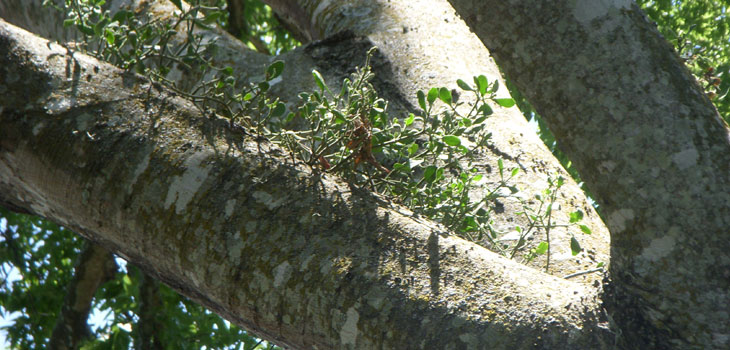
Mistletoe is a hemi-parasitic plant in the order Santalales that lives within the branches of a tree. Many different species of tree host mistletoe, here in central Texas it is most commonly found in cedar elms, hackberries, mesquite and red oaks.  It often goes unnoticed by homeowners as the mistletoe leaves can be confused with those of the host tree but, as all our local host trees are deciduous and the mistletoe is evergreen, it is very easy to spot in the winter months.

Mistletoe seeds are mostly spread by bird excrement. Once the seed is deposited on the branch the mistletoe will start using the host tree for water and minerals severely depleting the hosts  resources. Damage is also done to the branch structure of the host tree, accelerating decay and weakening the wood, which eventually can lead to branch failure.

There is no known solution to eradicating mistletoe from trees once the infection begins but the damage can be drastically reduced by having it  periodically removed by your ISA certified arborist as maintenance pruning is being performed in the host tree. The mistletoe will resume sprouting usually within a year but its development has been greatly reduced much to the benefit of the infected tree.


Benefits of mulch and proper application


Mulching is one of the biggest improvements in the health of a tree that a homeowner can make. It is also cheap and, if proper guidelines are followed, can be done without the help and oversight of an arborist.
One of the main benefits of mulch is the introduction of organic material in the soil. As I mentioned in my previous blog, urban trees are often starved of nutrients as we tend to remove all decomposing material from the surface of the soil to maintain a tidy look to our yards. In a forest, decomposing materials leech nitrogen, potassium and other valuable nutrients to the roots of the tree. Mulch makes up for these deficiencies in the urban landscape. Other benefits include improved water retention which is especially important for newly planted trees. It also helps keep competing grasses and weeds away from the roots which also benefit from the insulation the mulch offers, in other words it helps keep the soil temperature more stable, which in urban and suburban areas is often a problem.

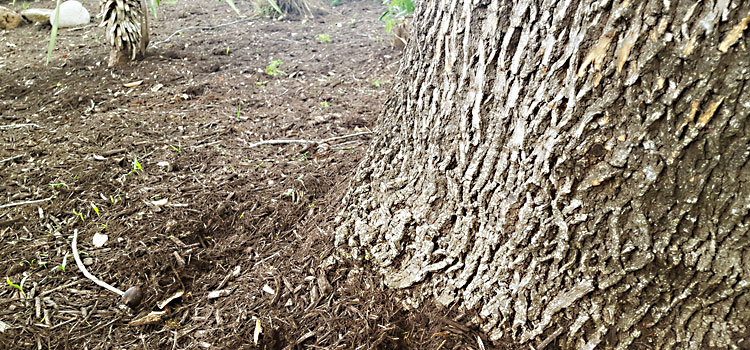
Mulching though, is a benefit to the tree only if applied properly. When done incorrectly it can seriously harm the tree so guidelines need to be followed. Mulch needs to be spread between 2″ to 4″ deep at most making sure that none of it comes into contact with the trunk of the tree as this could trap moisture around the wood and become an entry point  for decay. If practical it should be applied to at least the dripline of the tree but when possible even further as roots usually spread far past the canopy above.

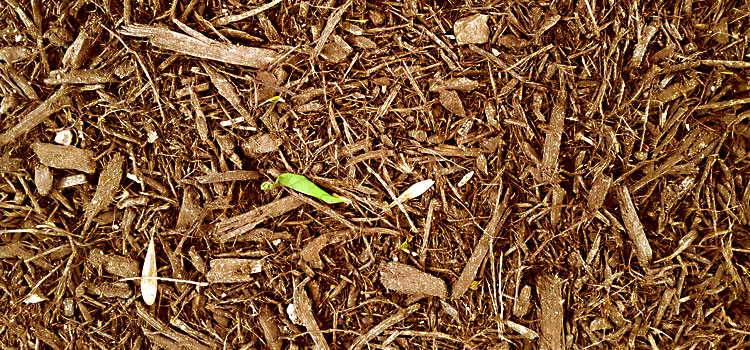
Any kind of organic hardwood mulch will do the job. You can buy it by the bag from your nursery, get it delivered by the yard from specific companies or ask your arborist to keep the mulch generated from the chippings of your pruning job.


Illustrations courtesy of the International Society of Arboriculture

Common tree problems in urban and suburban spaces

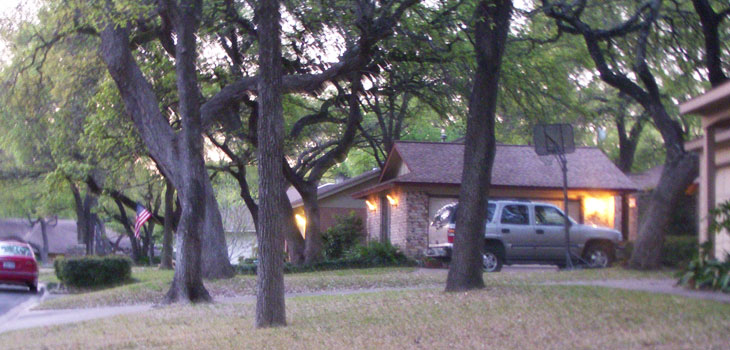
Suburban treesIn this first blog I want to address some of the most common and generic issues that trees face in an urban environment. Trees in an urban landscape face many problems that are not present in their natural habitat, the forest. These issues will be tackled in greater detail in future blogs.

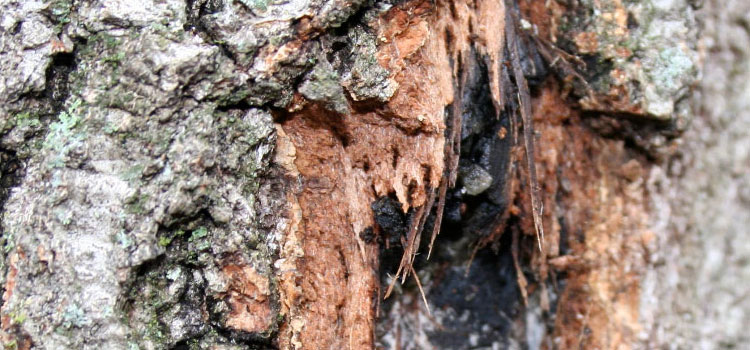
The roots that inhabit an urban soil lack an adequate amount of oxygen, bacteria, fungi and other organisms that are essential to the health of the tree. Urban soil has been described as “A soil material having a non-agricultural, manmade surface layer more than 50cm thick, that has been produced by mixing, filling, or by contamination of land surfaces in urban and suburban areas” (Bockheim,1974).

On the surface trees often have to compete for water and nutrients with turfgrass. A difficult coexistence that doesn’t occur in the trees natural habitat. This can be partially mitigated by mulching correctly, which will be the subject of the next blog.

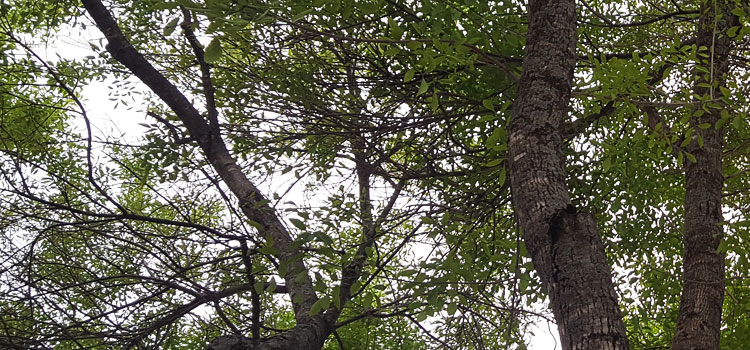
Codominant trunksAbove ground trees tend to grow into unnatural shapes due to excessive light stimulus from lack of competition from other trees. They will have a tendency to grow multiple trunks and very large lateral branches that eventually become too heavy for the wood to support. This is not only a concern for the health of the tree, as large tears along the trunk will become an entry point of decay and compromise the structure of the rest of the tree, but is also a hazard to people and property. To correct this structural and subordination pruning can be done when the tree is young to prevent bad structure from occuring in the first place. In mature trees the hazard can be partially reduced by weight and sail reduction pruning and, as a last resort, an ANSI approved cabling system.